

Hill Climb Racing
Fingersoft
I first came back to Hill Climb Racing because it is the kind of racing game that makes sense in small spare moments. You choose a vehicle, point it up a rough course, and try to keep it moving without flipping over or running out of fuel. That sounds simple, but the uneven ground turns every jump into a small driving puzzle. A careless landing can end a promising run, while a gentle touch on the accelerator can carry you much farther.
Fingersoft’s game has been around since September 22, 2012, and its staying power is easy to understand once you play it. It is a free racing game for Android, rated for Everyone, with an offline-friendly design that suits commutes, waiting rooms, and short breaks. The store summary describes it as an offline physics-based driving game, and that is a fair description of its central appeal: the challenge comes less from beating computer-controlled opponents and more from managing momentum, balance, terrain, and vehicle control.
My overall impression is positive, but not uncritical. This is not a polished simulation, a realistic motorsport experience, or a deep multiplayer competition. It is a compact arcade game built around repeated attempts and gradual improvement. If you enjoy learning a course through trial and error, it can be remarkably satisfying. If you want licensed cars, head-to-head races, or a campaign with a strong story, you will probably find its format too narrow.
Related News

How Audiobook Sync in Google Play Books Redefines Reading

Race Master 3D: The Ultimate Mobile Racing Challenge

Why Cricbuzz Keeps Cricket Fans in the Same Conversation
How the free model affects the value
The basic download is free, which makes trying it easy and removes the usual barrier for someone who only wants a casual racer. That matters here because the game’s appeal is personal: some players will immediately enjoy its rhythm, while others may find the physics deliberately awkward. You can test that feeling without paying first.
Optional in-app purchases range from $0.19 to $123.00 per item. That is the part I would consider carefully before spending anything. The free entry point offers a genuine way to experience the core driving loop, but the presence of a high-priced purchase option means I would not treat every available item as automatically good value. The sensible approach is to play long enough to decide whether the repeated climbing, upgrading, and retrying actually fits your habits.
Related News

Why WhatsApp Messenger Still Makes Everyday Communication Feel Easy

Jurassic World: The Game Is the Better Dino Tycoon for Strategic Players

Threads in Real Life: Who Should Join, Lurk, or Leave

How SHEIN Turned Shopping Into an Endless Content Feed

How to Make Fortnite Feel Smarter on Mobile

Should You Switch to Microsoft Outlook on Mobile?
In practical terms, the game works best when you regard purchases as optional convenience rather than a requirement for understanding it. I would not install it expecting a one-time paid product with every element neatly unlocked. Its value comes from the accessible starting point and the amount of play you personally get from improving your runs. If you dislike games that invite additional spending, the free version may still be worth testing, but you should keep your budget in mind before exploring the purchase screen.
The current version is 1.67.6, and the minimum operating-system requirement is Android 7.0. That makes it approachable for many older Android phones, although smooth performance can still depend on the individual device. I would check that your phone has enough comfortable storage and that touch controls feel responsive before judging the game too harshly; a delayed or crowded screen can make precise landings much more frustrating than they should be.
What you actually get from each run
The strongest part of the experience is the relationship between throttle and balance. Holding the accelerator constantly is rarely the best answer. On a steep rise, you need enough power to keep climbing, but after a jump the same input can rotate the vehicle into a dangerous landing. Releasing the throttle, tapping it briefly, or using the brake to influence the vehicle’s angle becomes part of the driving language.
Gallery
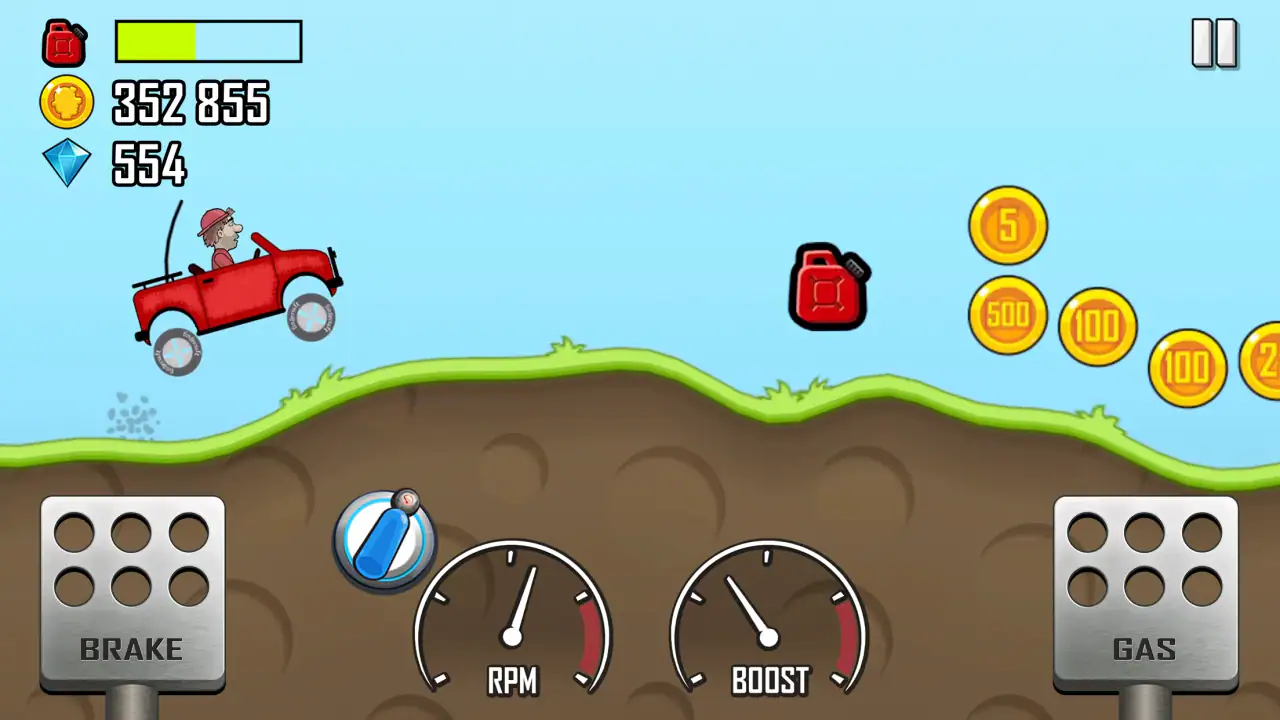
That makes the game feel more thoughtful than its cartoon presentation suggests. You are not simply reacting to obstacles; you are trying to predict how the vehicle will behave a moment later. A hill crest can launch you farther than expected. A downhill landing can put the wheels at an awkward angle. A short pause before the next bump may be more useful than maximum speed.
Fuel management adds another layer to longer attempts. Fuel pickups turn the course into a route-planning problem rather than a straight sprint. Sometimes the safest path is not the fastest one, because a controlled approach gives you a better chance of reaching the next refill. I found that this encourages looking ahead instead of treating every obstacle as an isolated jump.
Coins and distance give each attempt a clear purpose, even when the run ends early. A failed climb does not feel entirely wasted if it teaches you where to slow down or helps you work toward an improvement. That loop is the reason the game remains playable after the novelty of its simple controls wears off.
One useful habit is to separate learning runs from progress runs. On a learning run, I pay attention to the shape of the terrain and accept that I may crash while testing a jump. On a progress run, I use that knowledge to conserve fuel, protect the vehicle’s landing, and collect what is realistically within reach. Treating every attempt as a high-score attempt can make the game feel more stressful than it needs to be.
Why the physics are both the attraction and the problem
The physics create memorable moments because the vehicle never feels completely automatic. A clean landing can feel earned, especially when you correct the vehicle in midair and touch down with enough control to continue. At the same time, the same system can feel unpredictable when a small mistake produces a dramatic flip.
I would describe the handling as playful rather than realistic. That is good news if you want exaggerated jumps and quick restarts. It is less appealing if you expect the car to behave like a real vehicle on a real surface. The game asks you to learn its own rules, not to transfer driving knowledge from a simulator.
There is also a psychological trade-off in the retry structure. Because an attempt is short and restarting is easy, it is tempting to say, “one more run,” repeatedly. That can be enjoyable during a break, but it can also turn a five-minute session into a much longer one without you noticing. I recommend setting a stopping point before playing if you are using it during work or study time.
How it compares with other racing choices
Compared with traditional circuit racers, this game removes most of the pressure associated with overtaking, braking for corners, and memorizing a racing line. There is no need to fight a field of opponents every second. Your main rival is the terrain and your own control. That makes it easier to pick up, but it also means players seeking competitive racecraft may find it limited.
Compared with realistic driving games, it is much lighter and more forgiving in concept, even when the physics cause frequent crashes. You do not need a large screen, a controller, or a long uninterrupted session to understand what you are doing. The trade-off is a smaller sense of authenticity. It is a physics arcade game first, not a showcase for real-world car handling.
Compared with endless runners, the driving focus gives your actions more weight. You are not merely changing lanes or reacting to a fixed stream of hazards. The vehicle’s angle, speed, and fuel situation all influence the next decision. However, players who prefer constant novelty may find the repeated terrain-and-retry rhythm less exciting than an action game with more varied objectives.
For me, its best alternative is not another racing game but a different kind of short-session game. If I want a quick challenge that rewards patience and small improvements, this is a strong choice. If I want social competition, a large collection of licensed vehicles, or a sense of progression built around story missions, I would choose something else.
Everyday situations where it works well
Imagine having ten minutes before an appointment. You can start a run immediately, play without needing a network connection, and stop after a crash or a completed attempt. That is where the offline design has real value. It does not demand the commitment of a full race weekend or a long campaign session.
It also works well as a low-pressure travel companion. On a train or during a flight, the simple control scheme is easier to manage than a game that requires several buttons or constant online matchmaking. I would still avoid playing when motion or screen glare makes precise landings uncomfortable, because the game depends on seeing the terrain clearly and making small corrections at the right time.
For younger players, the Everyone rating makes it more approachable than many aggressive racing titles, although I would still pay attention to how optional purchases are handled on the device. The controls are easy to explain, but mastering them takes more patience than a child might expect from the colorful presentation.
It can also suit someone who likes measurable personal improvement. You can remember a difficult section, adjust your approach, and see whether the next attempt lasts longer. That makes it a useful choice for players who enjoy practice without needing a formal tutorial or a complex ruleset.
Where the experience may disappoint
The game is not ideal if you need a rich sense of variety from every session. Its core action remains focused on driving over uneven terrain, collecting useful items, and trying to extend a run. The simplicity is the reason it loads easily into a spare moment, but it is also the reason some players may reach their limit sooner than others.
It may also frustrate anyone who dislikes failure caused by momentum. The vehicle can flip because of a landing that looked almost safe, and learning the correct timing often requires several failed attempts. I enjoy that process, but I know it is not universally satisfying. If you prefer clear, predictable controls where success depends mainly on quick reactions, this may feel unfair even when the outcome follows the game’s physics.
Another limitation is the lack of a traditional race atmosphere. You are not usually measuring yourself against a pack of visible rivals fighting for position. The tension is quieter and more personal: how far can you go, how efficiently can you use the terrain, and can you improve the next attempt? That is a strength for some people and a weakness for others.
I would also be cautious about spending simply to remove a moment of friction. Because the game is free to begin and offers purchases across a wide price range, it is easy to confuse convenience with better value. I would only pay for something after deciding that it meaningfully improves the way I already play, rather than hoping a purchase will create an entirely different game.
Who is most likely to get good value?
This is a good fit for casual players who want an offline racing game with very simple controls but enough depth to reward practice. It is especially suitable for people who enjoy physics puzzles disguised as driving challenges. You do not need prior racing-game experience, and you can understand the basic objective almost immediately.
It is also a strong match for players who like incremental goals. Reaching a little farther, handling a familiar hill more cleanly, or making a risky jump consistently can provide enough motivation without a complicated progression system. I would recommend it to a friend who wants something easy to start but not completely mindless.
On the other hand, I would steer competitive racing fans toward a more conventional racer. If your favorite part of the genre is overtaking opponents, tuning a detailed car, or competing in structured events, this game does not center those pleasures. Likewise, players who dislike repeated retries should skip it, because repetition is not a side effect here; it is the main method of improvement.
Parents and shared-device users should remember that a game rated Everyone can still include optional purchases. The free price makes experimentation simple, but spending decisions should be handled deliberately, particularly when children can access the device. That is not a criticism of the driving itself; it is simply part of evaluating the full experience.
My practical approach to playing
I get more enjoyment by choosing one improvement target per session. On one attempt, I might focus on keeping the vehicle level over jumps. On another, I might concentrate on reaching fuel pickups without taking unnecessary risks. This prevents the game from becoming a blur of random crashes and gives each retry a clear purpose.
I also avoid chasing every collectible when the terrain becomes dangerous. A tempting item can draw you into a bad landing or make you spend too much fuel recovering. The better decision is often to preserve the run and collect what lies naturally along the safer line. That trade-off is easy to miss when the screen encourages you to grab everything.
Finally, I treat upgrades and purchases as part of a long-term decision rather than an instant solution. If the free play loop already feels rewarding, gradual improvement can be satisfying. If I am bored with the basic challenge, paying more will not necessarily fix that underlying problem. The game should earn my continued attention before it earns my money.
Final recommendation for Android players
With an average rating of 4.2 from around 11 million ratings and more than a billion installs, Hill Climb Racing clearly has broad appeal. Those figures do not guarantee that every player will enjoy its unusual handling, but they fit my experience of a game that is immediately understandable and surprisingly sticky once the physics start making sense.
My recommendation is to try the free version if you want a compact, offline-friendly racing game built around balance, fuel decisions, and repeated improvement. It offers real value without requiring an upfront payment, provided you are comfortable treating optional purchases cautiously. I would skip it if you need multiplayer rivalry, realistic motorsport, or constant variety.
For me, the winning quality is the way a tiny control scheme creates meaningful decisions. A tap, a release, or a carefully timed landing can change the entire run. That is not a complete racing simulation, and it does not pretend to be one. It is a focused arcade challenge that earns its place on a phone through quick sessions, readable goals, and physics that are occasionally irritating but often genuinely fun.
FAQs for Hill Climb Racing
What is Hill Climb Racing about?
Hill Climb Racing is a physics-based driving game where players control a vehicle driven by Newton Bill, an aspiring uphill racer. The objective is to navigate through various terrains, collecting coins and fuel cans while avoiding obstacles. With its simple controls and engaging gameplay, it challenges players to achieve the highest score possible.
Is Hill Climb Racing free to play?
Yes, Hill Climb Racing is free to download and play on both Android and iOS platforms. However, it does offer in-app purchases, which can enhance the gaming experience by allowing players to unlock new vehicles, stages, and other upgrades more quickly. These purchases are optional and not necessary to enjoy the game.
What devices support Hill Climb Racing?
Hill Climb Racing is available on a wide range of devices, including most smartphones and tablets running Android or iOS. The game is optimized to run smoothly on devices with different screen sizes and specifications. It requires a minimal amount of storage space, making it accessible to users with older devices as well.
How can I upgrade my vehicle in Hill Climb Racing?
Players can upgrade their vehicles by using the coins collected during gameplay. Upgrades can improve various aspects of the vehicle, such as engine power, suspension, tires, and 4WD. These enhancements help players tackle more challenging terrains and achieve higher scores. Coins can also be used to unlock new vehicles and stages.
Are there different modes or levels in Hill Climb Racing?
Hill Climb Racing features a variety of levels and terrains, such as countryside, desert, and arctic, each with unique challenges. Players can unlock new stages by progressing through the game and collecting enough coins. Each level presents different obstacles and requires strategic driving to progress further and achieve high scores.
Pros
- Engaging physics-based gameplay.
- Variety of vehicles to unlock.
- Numerous challenging levels.
- Simple and intuitive controls.
- Offline play capability.
Cons
- Repetitive level design.
- In-app purchases can be pricey.
- Limited vehicle customization.
- Ads can be intrusive.
- Graphics are quite basic.


